

Every wedding season the same question comes up between two families: how much should the haq mehr be? Because Islamic scholars measure mehr in silver, its value in rupees changes with the silver rate. Here are the 2026 figures, worked out from this week's rate.
Quick answer: at Rs6,368 per tola of silver (8 October 2026), the minimum mehr (2.625 tola, about 30.6 g of silver) is about Rs16,700, and Mehr-e-Fatimi (131.25 tola, about 1,531 g) is about Rs8.36 lakh. There is no legal maximum; the families agree the amount and write it in the nikah nama.
Haq mehr 2026 in rupees, at a glance
These figures use the 24-carat silver rate of Rs6,368 per tola reported on 8 October 2026. Silver moves daily, so recheck the rate the week of your nikah.
- Minimum mehr: 10 dirhams = 2.625 tola (about 30.6 g) of silver → about Rs16,716.
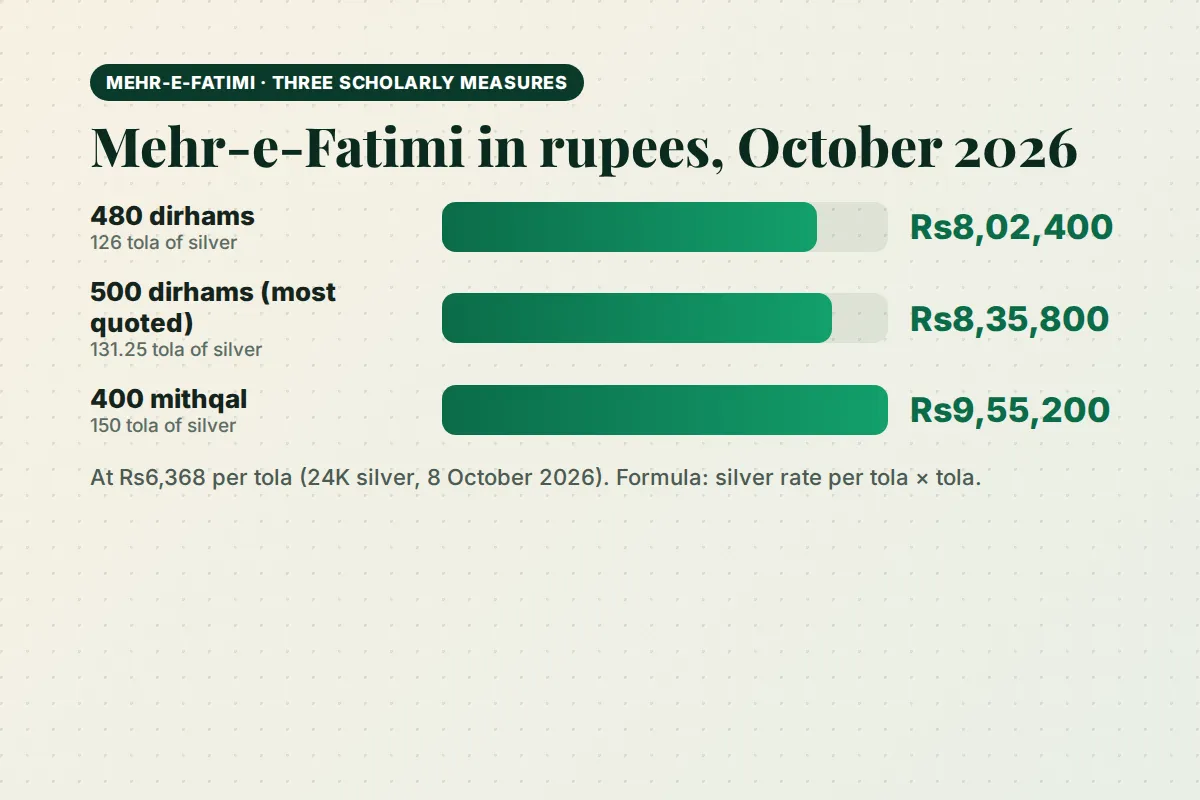
- Mehr-e-Fatimi (500 dirhams): 131.25 tola (about 1,531 g) → about Rs8,35,800.
- Mehr-e-Fatimi (480 dirhams): about 126 tola (1,470 g) → about Rs8,02,400.
- Mehr-e-Fatimi (400 mithqal): 150 tola (1,750 g) → about Rs9,55,200.
Why Mehr-e-Fatimi has more than one figure
Mehr-e-Fatimi is the mehr of Hazrat Fatimah (RA). Scholars agree on what it was but convert the old weights differently, so you will hear different numbers. A Hanafi answer on IslamQA lists the main views: 480 dirhams (about 1,470 g), 500 dirhams (131.25 tola, about 1,531 g), and 400 mithqal (150 tola, about 1,750 g). The 131.25 tola figure is the one most often quoted in Pakistan. If your family follows a particular scholar or masjid, ask the nikah khwan which measure they use.
How to work out the mehr yourself on the day
You only need one number: today's silver rate per tola, from any jeweller or the newspaper.
- Minimum mehr = silver rate per tola × 2.625.
- Mehr-e-Fatimi = silver rate per tola × 131.25 (or × 150 if your scholar uses that measure).
Example: if silver is Rs6,500 a tola, the minimum mehr is 6,500 × 2.625 = Rs17,063, and Mehr-e-Fatimi is 6,500 × 131.25 = Rs8,53,125. Round the figure the families agree, and write that exact number in the nikah nama.
Prompt or deferred: mu'ajjal and ghair mu'ajjal
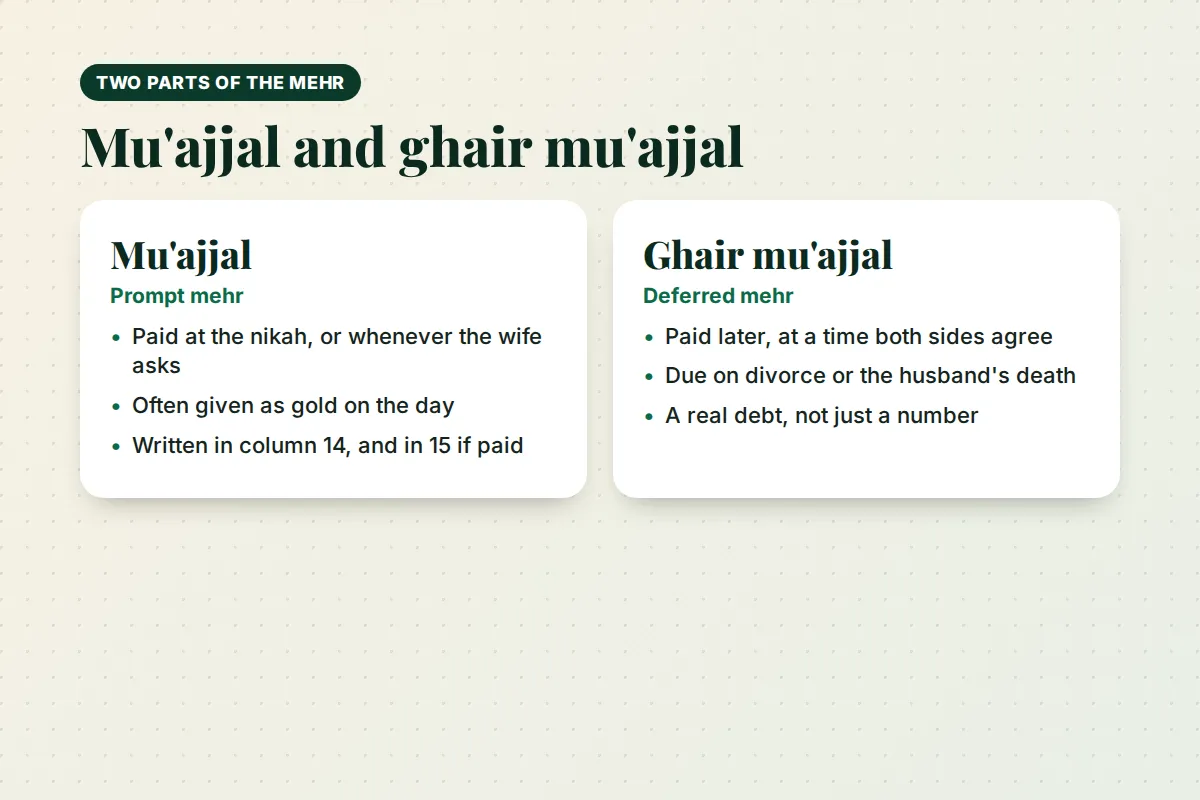
- Mu'ajjal (prompt): paid at the nikah or whenever the wife asks for it. Many families hand it over on the day, often as gold.
- Ghair mu'ajjal (deferred): paid later, at a time the two sides agree, and in any case due on divorce or the husband's death.
A common Pakistani pattern is part prompt, part deferred: for example, a gold set now and a cash amount later. Whatever you choose, the split is recorded in the nikah nama.
How to write the mehr in the nikah nama
The mehr goes in columns 13 to 16: the total, how much is prompt and how much deferred, how much was paid at the nikah, and any property or gold given instead of cash. In September 2026 the Supreme Court told nikah registrars to fill these columns fully and to describe any property given as mehr exactly, with its agreed value. So:
- Write a rupee figure, not "sharai mehr" or "as per custom".
- For gold, write the weight (tola or grams) and what it is, for example "one gold set, 3 tola".
- For a plot or house, write the address, size and agreed value.
Our guide to the nikah nama, column by column explains the rest of the form.
So how much should the mehr be?
There is no single right amount. Islam sets a minimum and encourages ease; Pakistani law sets no maximum. Most families settle on a figure that the groom can genuinely pay, often between the minimum and Mehr-e-Fatimi, sometimes more. A few practical points families find useful:
- Agree the mehr before the nikah day, between the elders, not on the stage.
- A mehr is a real debt. A big deferred figure that is never meant to be paid helps no one.
- If the bride's family wants security, prompt mehr in gold is more useful than a large deferred amount.
This is general information, not a fatwa or legal advice. For a ruling, ask your local mufti or the nikah khwan.
Mehr, jahez and gifts: not the same thing
Three things get mixed up in wedding talks, and it helps to keep them apart:
- Mehr is from the groom to the bride. It is her right and her property, and it is written in the nikah nama.
- Jahez (dowry) is what the bride's family gives. It is a custom, not a requirement, and it does not replace or reduce the mehr.
- Bari and salami are gifts from the groom's side and from relatives. They are not mehr unless the families agree and write them in the nikah nama as mehr.
If a gold set from the groom's family is meant to count as the mehr, say so clearly and write it in column 16 with its weight. Otherwise it is a gift, and the mehr is still owed.
Mehr settled, date fixed: the invitation
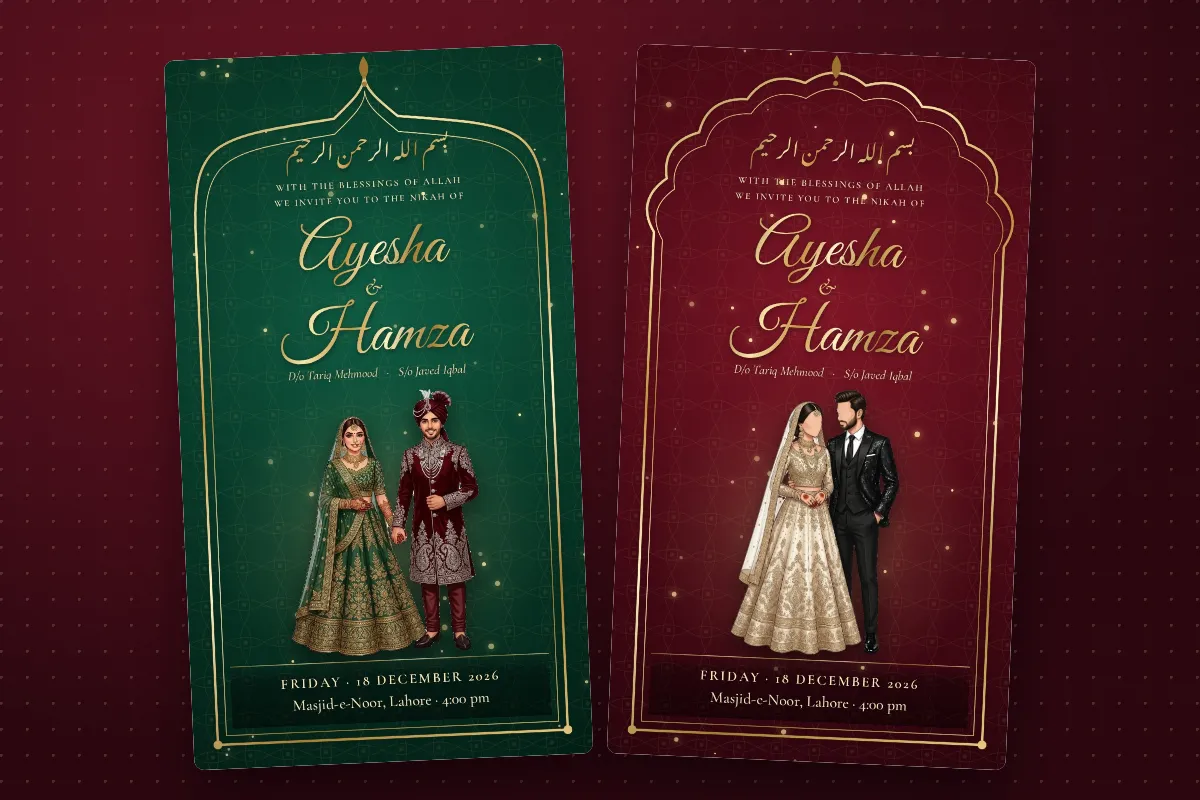
Once the families have agreed the mehr and the date, the card is the easy part. The nikah invitation card maker has 40 designs in emerald or maroon with gold, in English or Urdu, and you can download it for WhatsApp or as a PDF. For the words, see our nikah invitation card wording samples, and to send it nicely, the wedding invitation message guide.


