

The date is fixed, the hall is booked, and now someone in the family asks, "Card pe likhna kya hai?" Getting the nikah invitation card wording right matters, because this one card will be read by elders, forwarded across family groups and saved on phones until the day itself.
Quick answer: good nikah invitation card wording follows a set order: Bismillah at the top, a line naming the occasion, the bride's name with her father's name, the groom's name with his father's name, then the day, date, time and venue, and finally the hosts or a "Muntazir" line with one contact number. Keep each item on its own short line, in English or Urdu.
What to write on a nikah card, line by line
The nikah is the formal ceremony where the marriage contract is signed, so the card for it tends to be more formal than a mehndi or dholki card (see marriage customs in Pakistan for how the events fit together). Most Pakistani nikah cards use these lines, in this order:
- Bismillah. بسم اللہ الرحمن الرحیم in Arabic script, or "Bismillah ir-Rahman ir-Raheem" in English.
- The occasion. "Nikah ceremony" or بسلسلہ تقریبِ نکاح.
- The bride. Her name, then "D/o" and her father's name.
- "With" or ہمراہ. One small word that joins the two names.
- The groom. His name, then "S/o" and his father's name.
- When. Day, date and time together, e.g. "Saturday, 19 December 2026 · 7:00 pm".
- Where. The venue name and city. Leave the full address for a map link.
- Hosts or note. "Muntazir: Tariq family · 0300 …" or a short dua.
That is all a card needs. Anything longer is better said in a message under the card or on an invitation website.
Formal nikah invitation card wording in English
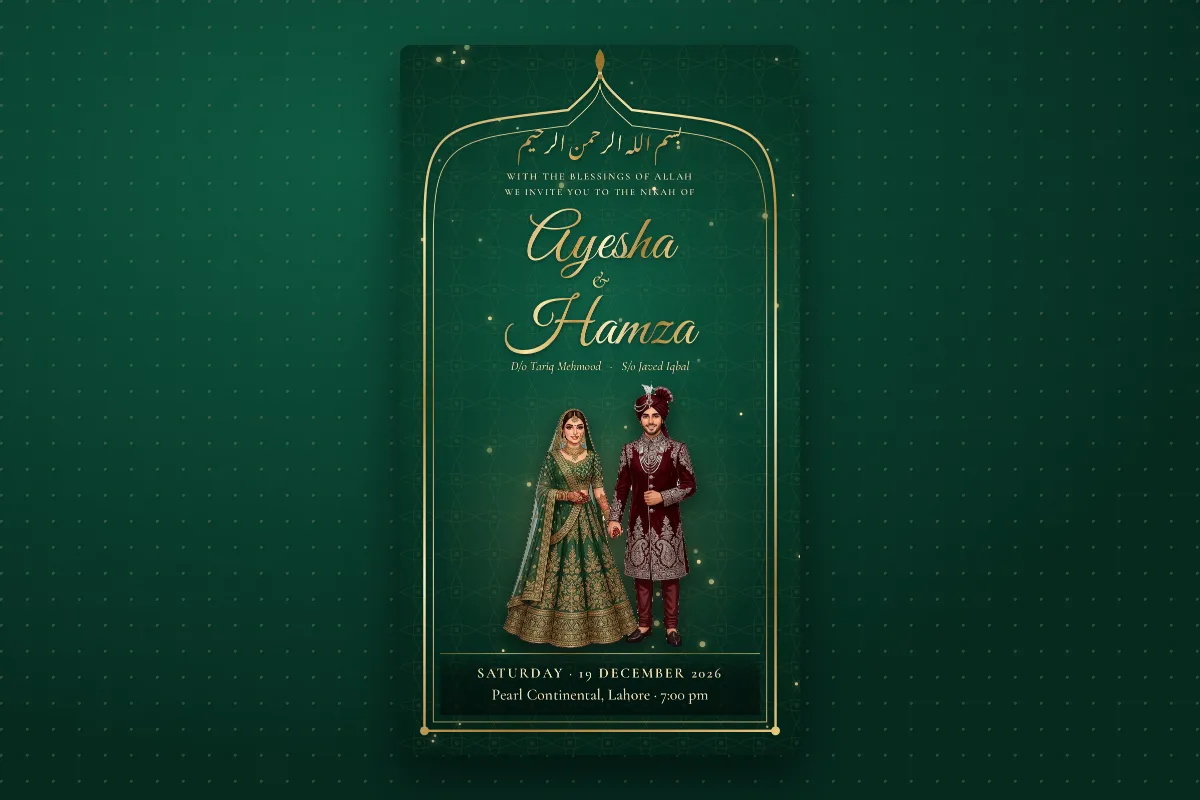
This is the classic version, suited to printed-style cards and to elders who expect formal language:
Bismillah ir-Rahman ir-Raheem
With the blessings of Allah
Mr Tariq Mehmood and family
request the pleasure of your company
at the Nikah of their daughter
Ayesha
with
Hamza
S/o Mr Javed Iqbal
Saturday, 19 December 2026 · 7:00 pm
Pearl Continental, Lahore
A slightly warmer version, where both families invite together:
Bismillah ir-Rahman ir-Raheem
Together with their families
Ayesha
D/o Tariq Mehmood
and
Hamza
S/o Javed Iqbal
invite you to their Nikah
Saturday, 19 December 2026 at 7:00 pm
Pearl Continental, Lahore
Your presence and duas will mean a great deal to us
And a short, modern version for couples who want a clean card with plenty of space around the names:
Bismillah
Ayesha & Hamza
are getting married
Nikah · Saturday, 19 December 2026 · 7:00 pm
Pearl Continental, Lahore
Muntazir: Tariq family · 0300 …
All three work. Choose the formal one if most guests are elders and relatives, and the short one if the card is mainly for friends and cousins who will read it on a phone in a few seconds.
Nikah card wording in Urdu
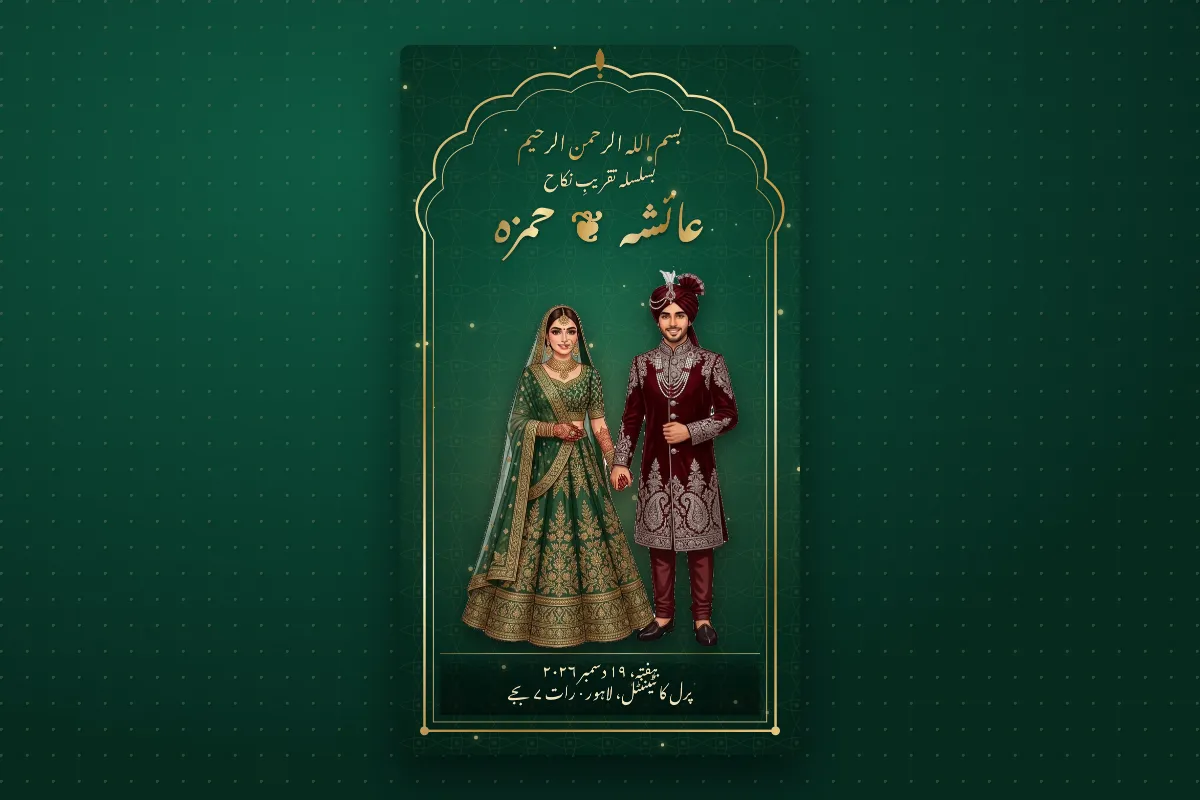
Urdu wording has its own formal phrases that elders recognise immediately. Use عزیزہ before the bride's name and عزیزم before the groom's, بنت and ابنِ for "daughter of" and "son of", and write the date with Urdu numerals.
بسم اللہ الرحمن الرحیم
بسلسلہ تقریبِ نکاح
عزیزہ عائشہ
بنت جناب طارق محمود
ہمراہ
عزیزم حمزہ
ابنِ جناب جاوید اقبال
بروز ہفتہ، ۱۹ دسمبر ۲۰۲۶، رات ۷ بجے
بمقام پرل کانٹینینٹل، لاہور
آپ کی شرکت ہمارے لیے باعثِ مسرت ہوگی
منتظرین: طارق محمود و اہلِ خانہ
A few things to check in Urdu:
- Numerals: write ۱۹ دسمبر rather than 19 December, so the line reads cleanly right to left.
- Time: "رات ۷ بجے" or "شام ۶ بجے" reads more naturally than "7:00 pm".
- Font: Nastaliq looks traditional and is what most families expect. The Urdu nikah card maker sets the whole card in Nastaliq and writes dates and times this way for you.
Short nikah invitation message for WhatsApp
Most invitations now travel on WhatsApp, and the card picture usually goes with a short message underneath. Keep it to three or four lines so it shows in full in the chat preview.
Assalam-o-Alaikum!
Alhamdulillah, Ayesha and Hamza's Nikah is on Saturday, 19 December at 7:00 pm, Pearl Continental Lahore.
We would love you to join us. Please keep them in your duas.
السلام علیکم!
الحمدللہ، عائشہ اور حمزہ کا نکاح بروز ہفتہ، ۱۹ دسمبر، رات ۷ بجے پرل کانٹینینٹل لاہور میں ہے۔
آپ کی شرکت اور دعاؤں کے منتظر ہیں۔
If you are sending to many groups, note that WhatsApp limits forwarding to five chats at a time, and messages that have been forwarded many times can only go to one chat at once. Sending the card fresh from your gallery to each group avoids this.
Islamic wedding invitation wording with a dua
Many families like to add a dua for the couple instead of, or under, the hosts' line. The well-known Sunnah dua for newlyweds is:
بارک اللہ لکما و بارک علیکما و جمع بینکما فی خیر
In English it is often written as "Barakallahu lakuma wa baraka alaykuma wa jama'a baynakuma fi khayr", meaning "May Allah bless you both, send blessings upon you, and bring you together in goodness." Other gentle lines that suit a nikah card:
- "With the blessings of Allah and the duas of our elders"
- "Please join us as two families become one"
- "Your duas are the best gift"
Keep Quranic verses and Arabic text short and check the spelling carefully, because a nikah card is often kept for years.
Wording for a nikah and walima on one card
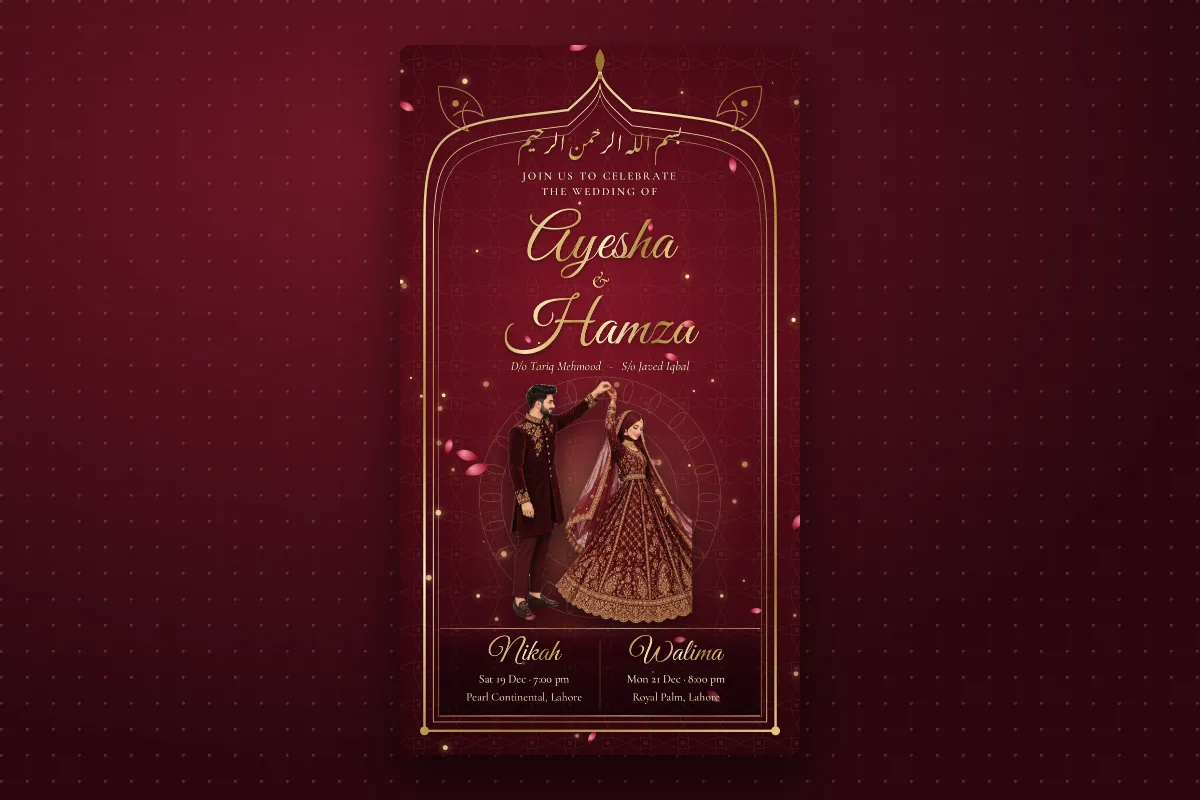
If the nikah and walima are a day apart, one card with both events saves guests from juggling two messages. Give each event its own block with day, date, time and venue:
| Event | Day and date | Time | Venue |
|---|---|---|---|
| Nikah | Saturday, 19 December 2026 | 7:00 pm | Pearl Continental, Lahore |
| Walima | Sunday, 20 December 2026 | 8:00 pm | Royal Palm, Lahore |
The names, Bismillah and hosts' line appear once at the top, and each event sits underneath. A nikah and walima card lays the two events side by side so they are easy to tell apart. For the walima on its own, the walima card wording guide has samples that match the tone of these.
Common wording mistakes on nikah cards
- Missing the day. "19 December" alone causes confusion. Always write "Saturday, 19 December".
- Vague timing. "After Isha" means different things to different people. Give a clock time.
- Mixed spellings. Pick "Nikah" or "Nikkah" and use it everywhere, along with one spelling of each name.
- Too many phone numbers. One family number is enough on a card that will be forwarded widely.
- English and Urdu on the same line. Mixing scripts on one line breaks the reading direction. Make one card in each language instead.
- A full address on the card. It crowds the design. Write the venue and city, and share a map link in the message.
Putting the wording on your card
Once your wording is ready, the design does the rest. On the nikah card and invitation maker you type the names, fathers' names, date and venue once, choose English or Urdu, and switch Bismillah and the fathers' names on or off. The card page shows ready-to-copy wording in both languages, so you can paste the matching WhatsApp message under the card. If you are still choosing colours, our nikah card design ideas walk through the emerald and maroon styles.
A nikah card only has a few lines, so let each one be clear: who, when, where, and a dua for the two people at the centre of it all.


