

Before the mehndi, the barat and the walima, there is the dholki: cousins on the floor with a dholak and a spoon, aunties leading the tappay, and someone recording it all on a phone. It is the least formal part of the shaadi, and the invitation can be too.
Quick answer: good dholki card wording says whose dholki it is, lists every night with the day, date and start time, gives the venue (usually "at our home" with the area and city), and adds one fun or dress-code line. Keep it short enough to read on WhatsApp, and send it in English and Urdu if the guests are mixed.
What a dholki is, and why the card is different
A dholki is an evening of wedding songs at home, named after the small dholak drum that sits in the middle of it. Families in Lahore, Faisalabad and Rawalpindi often hold several dholki nights in the week before the mehndi, sometimes every evening. It is mostly women and girls, close family and neighbours, though everyone ends up dancing by the last night.
Because it is at home and informal, the dholki card is lighter than a barat or nikah card. You can drop the parents' full names, use the bride's or groom's first name, and add a line about the songs. What you cannot drop is clarity: with several nights, guests need to know exactly which evenings and what time.
Who hosts the dholki, and who to invite
The bride's family usually holds the first dholki at home, and the groom's family often has its own on the same nights. In big families an aunt, a phuppo or a close neighbour may host one evening each, which is why the card should say clearly whose house it is.
The guest list is smaller than the barat: close relatives, the bride's friends from school or university, and the women of the mohalla. Many families send the dholki card only to the family WhatsApp groups and to a handful of friends. If gents are welcome on one night only (often the last, before the mehndi), say so on that night's line.
What to include on a dholki card
- The heading: "Dholki", "Dholak Night" or "بسلسلہ تقریبِ ڈھولکی".
- Whose dholki: "Ayesha's Dholki" or "Dholki of Hamza".
- Every night: day, date and start time for each one.
- Venue: "At our home, Gulberg, Lahore". Share the full address privately.
- One extra line: dress code, "bring your voices", or "ladies only" if it is.
- Host: the family or the person to call.
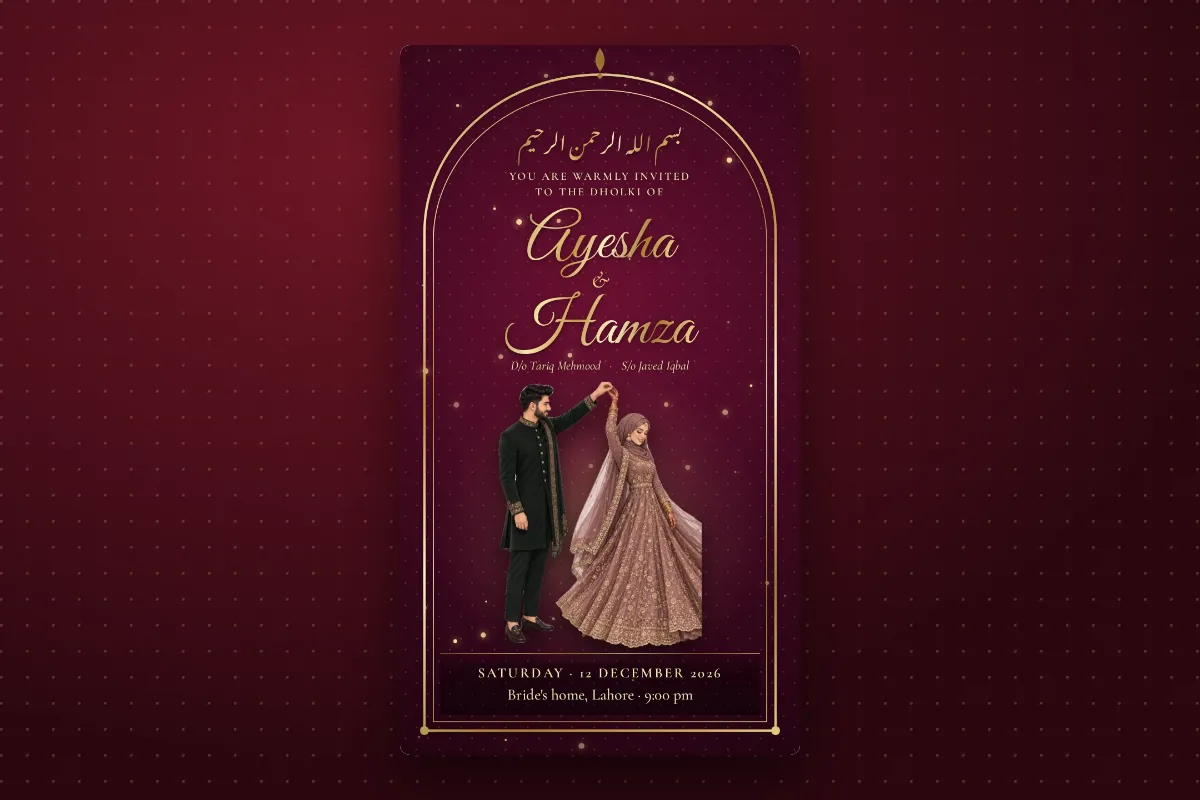
Playful dholki card wording in English
These suit a WhatsApp card for cousins and friends:
Dholak, tappay and lots of chai!
Join us for Ayesha's Dholki
Friday 4 & Saturday 5 December 2026
9:00 pm onwards
At our home, Gulberg, Lahore
Bring your voices and your best dance moves.
— The Tariq family
The countdown has begun!
Hamza's Dholki Nights
1 to 5 December 2026 · Every night after Isha
Our home, Johar Town, Lahore
No excuses, only dancing.
Formal dholki invitation wording
For elders, office colleagues or relatives you see once a year:
Bismillah ir-Rahman ir-Raheem
Mrs & Mr Tariq Mehmood
request the pleasure of your company
at the Dholki of their daughter
Ayesha
on Saturday, 5 December 2026 at 8:30 pm
At our residence, DHA Phase 5, Lahore
RSVP: Hina Tariq · 0300 0000000
Dholki card in Urdu
Many families send the Urdu card to the khandan group and the English one to friends. A natural Urdu version:
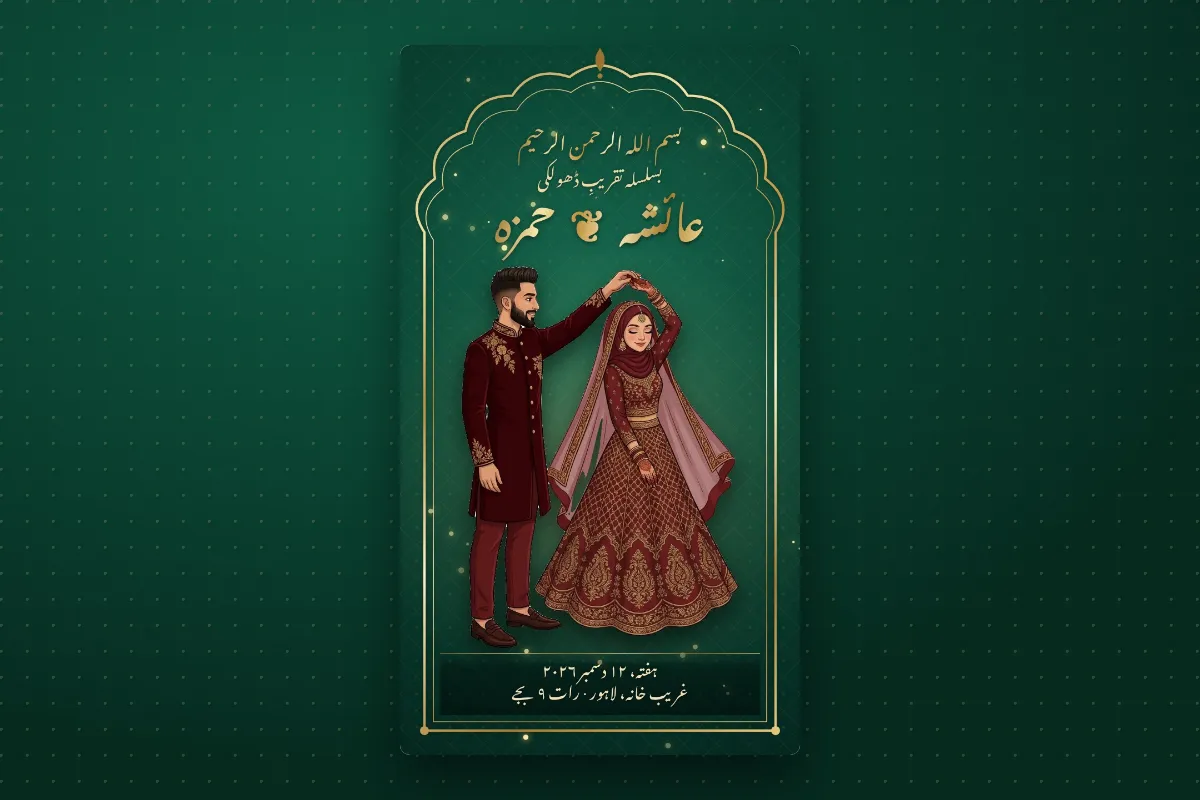
بسم اللہ الرحمن الرحیم
بسلسلہ تقریبِ ڈھولکی
عزیزہ عائشہ کی شادی کی خوشی میں
ڈھولکی کی محفل میں آپ کی شرکت ہمارے لیے باعثِ مسرت ہوگی
بروز جمعہ و ہفتہ، ۴ اور ۵ دسمبر ۲۰۲۶
وقت: رات ۹ بجے
بمقام: غریب خانہ، گلبرگ، لاہور
منتظرین: طارق محمود و اہلِ خانہ
"غریب خانہ" is the polite, humble way to say "our home", and elders will expect it. A shorter version for a WhatsApp picture:
ڈھولکی
عائشہ کی شادی کی خوشی میں
جمعہ، ۴ دسمبر · رات ۹ بجے
غریب خانہ، گلبرگ، لاہور
Roman Urdu lines for the card or the message
Roman Urdu reads fastest in family WhatsApp groups. Pick one:
- "Ayesha ki dholki hai, aap ke baghair adhoori hai!"
- "Dholak bajegi, tappay gaye jayenge, bas aap ki kami hai."
- "Shaadi ki raunaq dholki se shuru hoti hai. Zaroor aaiye ga."
- "Mehfil-e-dholki: Jumma raat 9 baje, hamare ghar."
Dholki invitation message for WhatsApp
Send the card as a picture and type a short message under it:
Assalam o Alaikum! Ayesha's dholki is on Friday 4 and Saturday 5 December at our home in Gulberg, from 9:00 pm. Please come and bring the girls. Card attached. — Hina Tariq
Or in Urdu:
السلام علیکم! عائشہ کی ڈھولکی جمعہ اور ہفتہ، ۴ اور ۵ دسمبر کو رات ۹ بجے ہمارے گھر گلبرگ میں ہے۔ آپ کا انتظار رہے گا۔
The dholki card maker shows ready wording in both languages next to the card, so you can copy the message after you download.
Dress-code and timing notes
One short note is enough. Some that families actually use:
- Colour theme: "Dress code: yellow and green" or "Wear something bright".
- Comfort: "Floor seating, come comfortable".
- Ladies only: "Ladies' dholki", if the gents are not invited.
- Start time: "Dholak starts at 9:00 pm sharp" (it never does, but it helps).
- Neighbours: finish by a sensible hour and let next door know, or simply invite them.
Dholki and mehndi as a matching pair
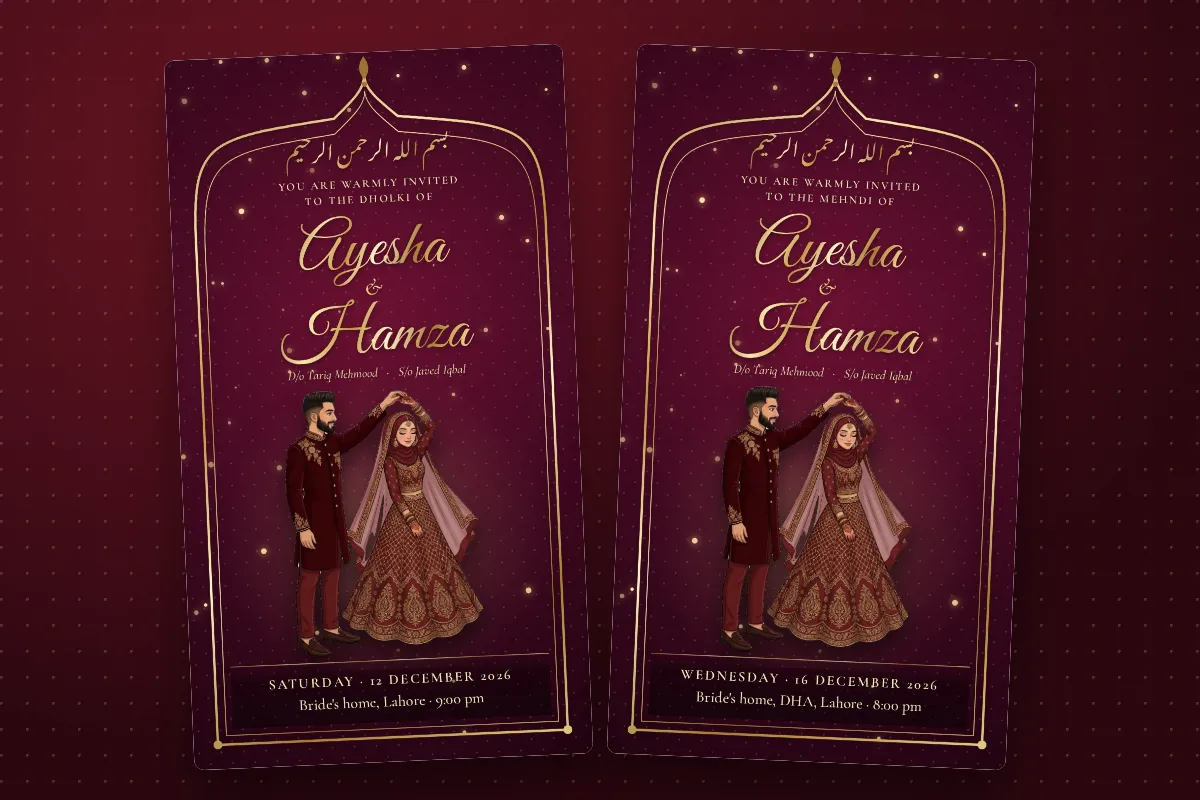
The dholki usually leads straight into the mehndi, so many families make both cards in the same design, often jade or emerald for the dholki and a warmer wine or maroon for the mehndi. Make your mehndi card in the same style, and see our mehndi card wording guide for lines that match the tone above. If you are also doing the barat card, our barat card wording post covers both families' versions.
One card per night, or all the nights on one?
If there are two or three dholki nights at the same house, put them all on one card. If different relatives are hosting different nights at different homes, make one card per night so nobody turns up at the wrong house. You can fit up to four events on one card, make one card per event, or make the whole set, including the shaadi card for the main days.
Designs, downloads and a link for the whole week
There are 40 designs, in emerald and maroon with gold, with an illustrated couple, a faceless or back-view couple, or no picture, in English or Urdu (Nastaliq). Download a 1080×1920 picture for WhatsApp or a PDF to print, free and without signing up.
When the programme runs all week, an invitation website keeps every dholki, the mehndi and the barat in one link, with a countdown, Google Maps directions and RSVP with guest count. You can preview it with your own names before making a free account.
Keep the dholki card light, make the dates impossible to miss, and save the formal wording for the big days.


