

On the nikah day the nikah nama usually arrives in the last ten minutes: the nikah khwan fills it quickly, someone says "this column is not needed", and both sides sign. But it is a legal contract, and some of its columns decide the mehr, the bride's rights and what happens if things go wrong.
Quick answer: the nikah nama has 25 columns. Columns 1–12 record who is marrying, the vakils, the witnesses and the date. Columns 13–16 record the mehr, 17 any special conditions, 18 whether the right of divorce is delegated to the wife, 19 any limits on the husband's right of divorce, 20 documents about mehr and maintenance, and 21–22 whether the groom already has a wife. Read these before anyone signs.
Why the nikah nama is in the news in 2026
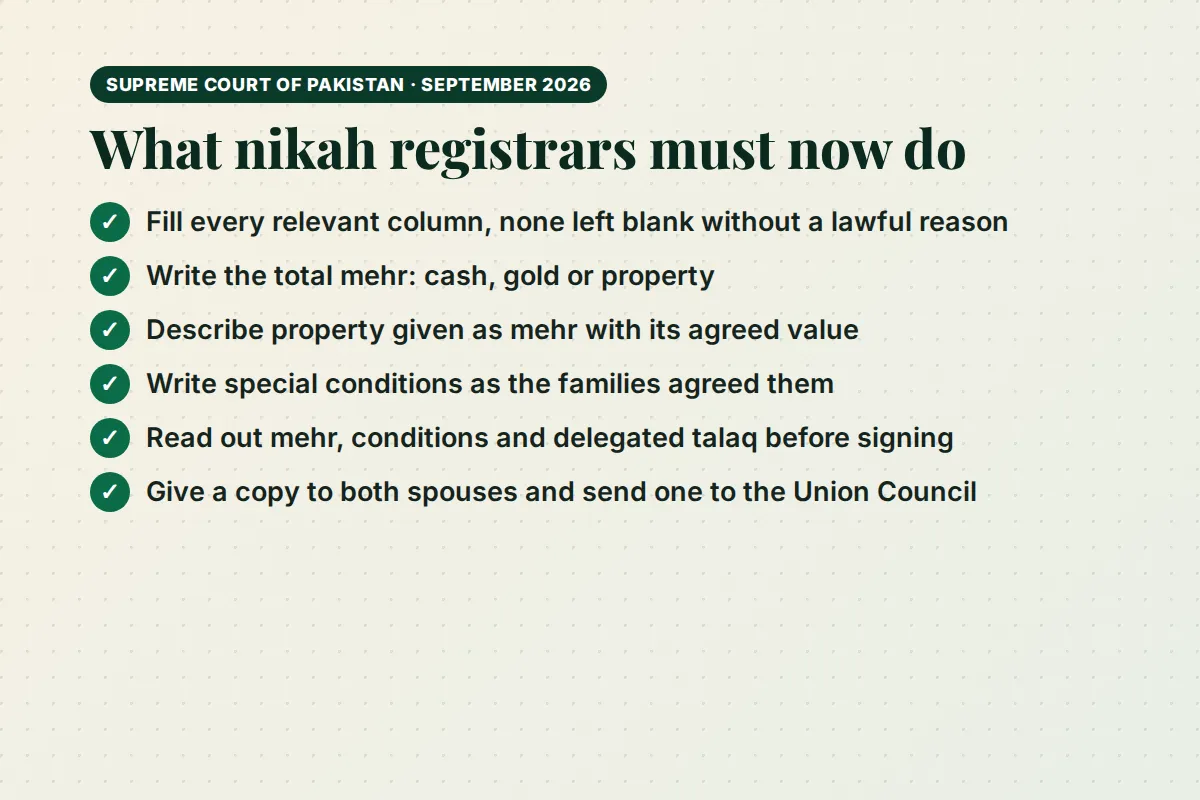
In September 2026 a four-member bench of the Supreme Court of Pakistan told nikah registrars to fill every relevant column of the prescribed nikah nama. The judgment, reported by ProPakistani, says no column should be left blank or treated as unnecessary without a lawful basis. It also says registrars must:
- write the total mehr in column 13, whether it is cash, jewellery or property;
- describe any property given as mehr in column 16: what it is, its size, location and agreed value;
- write special conditions in column 17 as the two families actually agreed them, not in the registrar's own words;
- read out or explain the mehr, special conditions and delegated talaq entries before anyone signs or gives a thumb impression;
- give copies to both spouses and send the required copy to the Union Council.
The court also repeated that mehr is a mandatory requirement of the marriage and that courts must enforce it if it is not paid. In short: the blanks that families have skipped for years now matter more.
Columns 1–12: who, where and when
The first part identifies the marriage. Check the spellings against the CNICs, because these details go into NADRA's record and onto the marriage certificate.
- 1: ward, town or union council where the nikah takes place.
- 2–3: the groom's name, father's name, address and age.
- 4–6: the bride's name, father's name, address, whether she is unmarried, widowed or divorced, and her age.
- 7–10: the vakil (representative) of each side and the witnesses to that appointment.
- 11: the witnesses to the nikah itself.
- 12: the date of the nikah.
Columns 13–16: the mehr
This is where most disputes start, so write it carefully.
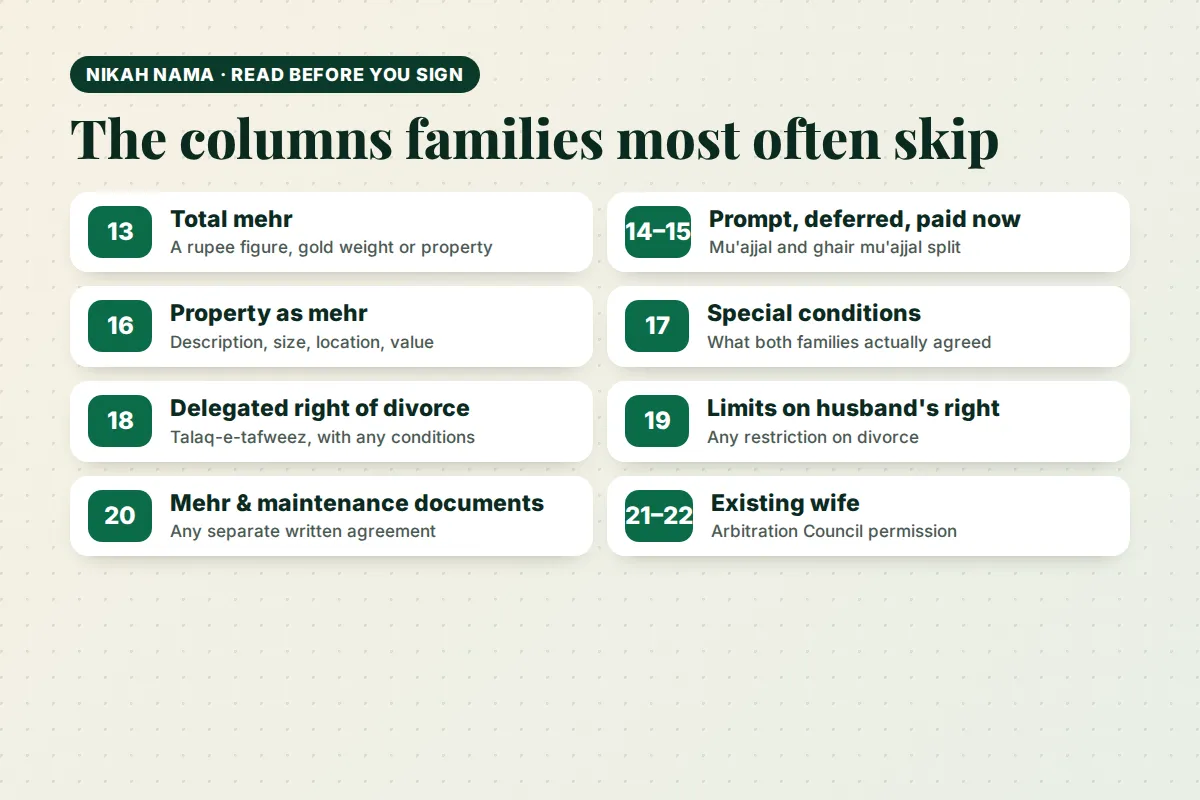
- 13, total mehr: the full amount or value agreed. Write a figure, not "sharai mehr" or "as per custom".
- 14, prompt and deferred: how much of the mehr is mu'ajjal (paid at the nikah or on demand) and how much is ghair mu'ajjal (paid later).
- 15, paid at the nikah: whether any part was actually paid at the time, and how much.
- 16, property as mehr: if gold, a plot or a house is given in place of all or part of the mehr, describe it exactly and give its agreed value.
If gold is part of the mehr, write the weight in tola or grams as well as the description, so there is no argument later about which set it was. For the minimum mehr and today's value of Mehr-e-Fatimi in rupees, see our guide to haq mehr in 2026.
Column 17: special conditions
Either side can add terms here, as long as they are lawful. Families add things like a monthly allowance for the wife, where the couple will live, the bride continuing her studies or job, or an agreed amount if the marriage ends. The 2026 judgment says this column must show what the two sides actually agreed, so write the conditions down before the day and read them out at the nikah.
Columns 18 and 19: the right of divorce
- 18, delegated right of divorce (talaq-e-tafweez): the husband can delegate his right of talaq to the wife, fully or on conditions. It is separate from khula: with a delegated right the wife does not have to go to court, and she keeps her mehr. If this column is crossed out, nothing is delegated.
- 19, limits on the husband's right: whether the husband's right of divorce is restricted in any way, for example by a payment he must make.
Many families find these columns awkward to discuss. That is exactly why they should be discussed calmly before the day, between the elders of both sides, rather than crossed out in a hurry at the stage.
Columns 20–25: documents, existing marriages and registration
- 20: whether any separate document about mehr and maintenance has been made.
- 21–22: whether the groom already has a wife and, if so, the permission of the Arbitration Council under the Muslim Family Laws Ordinance, with its number and date.
- 23–25: who solemnised the nikah, the date of registration and the fee paid.
Column numbers can differ slightly on older or provincial versions of the form, so match by the heading, not only the number.
A simple checklist for the nikah day
- Get a blank nikah nama from the registrar or Union Council a week before and read it at home.
- Agree the mehr (total, paid now, paid later, any gold or property) between the families and write it down.
- Agree any special conditions and the answers to columns 18 and 19.
- Bring CNIC copies of the bride, groom, vakils and witnesses so the details match.
- Ask the nikah khwan to read the mehr and conditions aloud before signing.
- Take your own copy home, and later get the computerised marriage certificate from the Union Council.
This guide explains the form; it is not legal advice. For a specific situation, speak to a family lawyer or your Union Council.
Then the easy part: the invitation
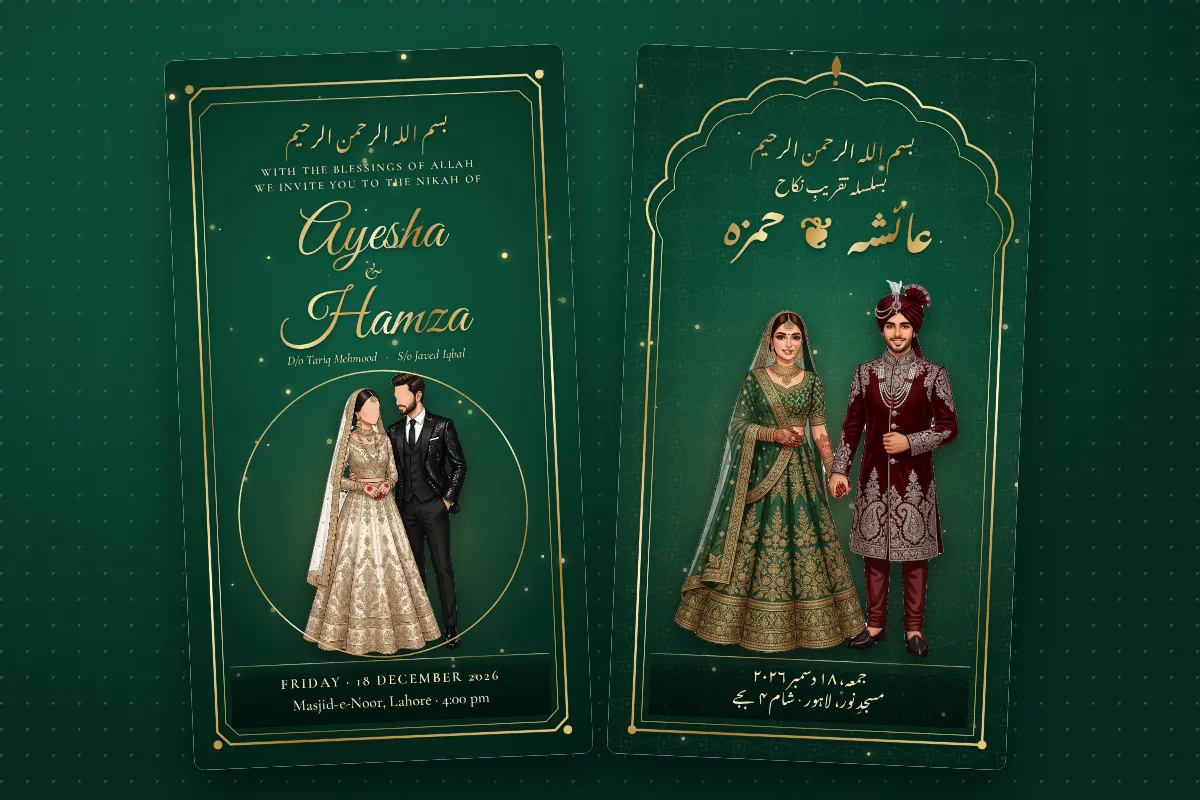
Once the families have agreed the nikah details, the card takes a few minutes. On the nikah invitation card maker you type the names, date and venue once, pick one of 40 emerald or maroon designs, and download it for WhatsApp or as a PDF to print, in English or Urdu. For wording ideas, see our nikah invitation card wording samples, and if the rukhsati is the same day, the nikah and rukhsati card wording guide.


