

You typed the names, the heart filled up, and it stopped at 63%. Now the real question: is 63% good? Should you send it? Every love percentage calculator gives a number, but almost none of them tell you what the number means.
Quick answer: a love percentage calculator turns two names into a score from 0 to 100% using a fixed formula. On most calculators, 70% and above is a strong match and 85% and above is "made for each other". It is a fun love test, not a prediction. You can check yours on ChatWrapper's love calculator, which also tells you who loves more and who texts first.
Every love percentage, explained
Here is how we read each range on ChatWrapper (with the line you'll see under your result):
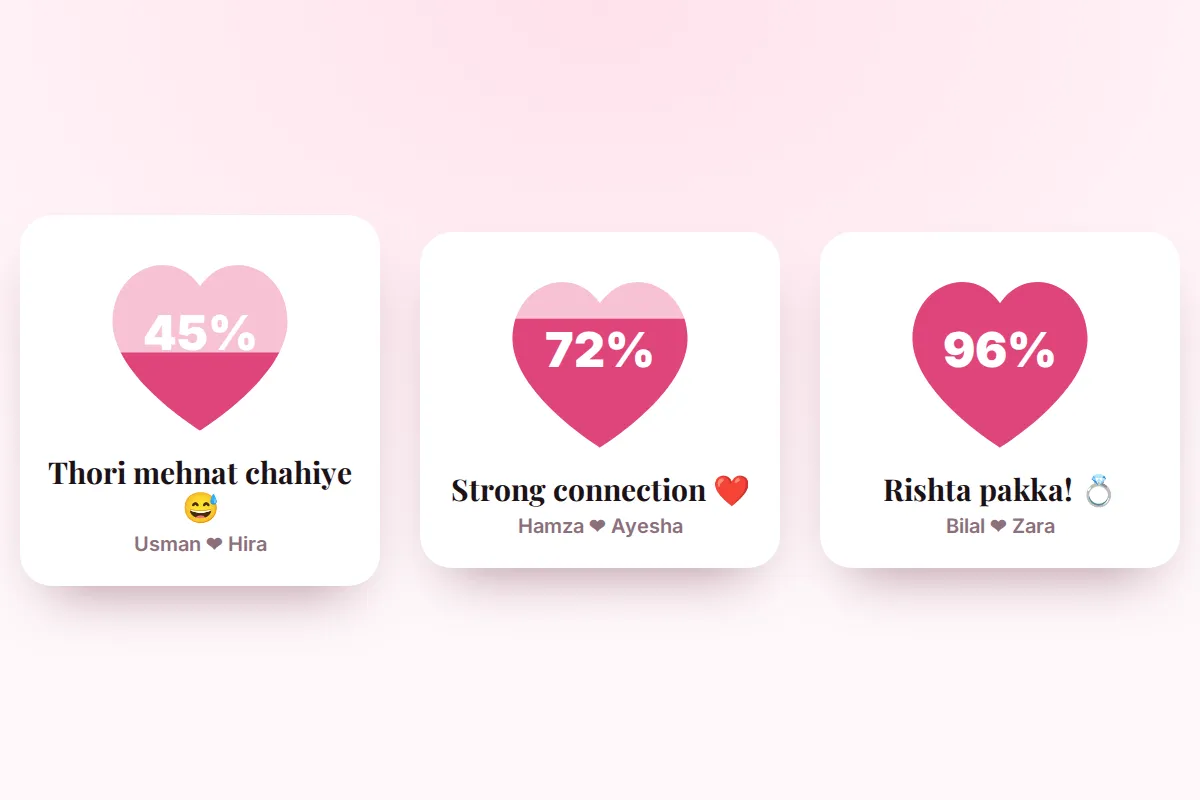
95–99%: "Rishta pakka! 💍"
The top of the love meter. This is the screenshot you post without a caption because the number speaks for itself. Expect your friends to start asking about dates.
85–94%: "Made for each other 💕"
A love percentage most people would be happy with. Strong enough to send to the other person, which is exactly what you should do.
70–84%: "Strong connection ❤️"
A solid score. Not perfect, but very few real couples are. This range is common for long-term couples, and it's a good reminder that "pretty great" is great.
55–69%: "Kuch to hai 😏"
Something is there. This is the classic crush score: not a no, not a yes. The love test is telling you to keep the conversation going.
40–54%: "Thori mehnat chahiye 😅"
A little effort needed. Reply faster, remember their favourite chai, and send a chocolate. Love percentages don't move, but people do.
Under 40%: "Dosti hi theek hai 🤝"
The friend zone, officially. Before you panic, try their full name or nickname: a different name gives a different score. And if you're testing your best friend, a low score is honestly the right answer.
How a love percentage calculator works
Under the hood, every love meter does the same thing: it turns text into a number. The old paper method counted the letters of "LOVES" in both names. The FLAMES game crossed out matching letters. Online calculators usually turn the names into a long number and scale it to a percentage.
The rule that separates a good calculator from a bad one is consistency:
- Same names, same score. Press the button ten times, get the same answer ten times.
- Order doesn't matter. "Hamza + Ayesha" must equal "Ayesha + Hamza".
- Capitals don't matter. "ali" and "ALI" are the same person.
ChatWrapper's love percentage calculator follows all three, which is why people trust it enough to send the result to the other person.
Love calculator by name vs by date of birth
| By name | By date of birth | |
|---|---|---|
| What you need | Two first names | Both birthdays (sometimes birth times) |
| Works for a crush | Yes, you know their name | Only if you know their birthday |
| Style | Quick, shareable, a bit silly | Star signs and numerology |
| Best for | Fun with friends, sending to them | People who enjoy astrology |
Most people search for a love calculator by name because it's instant and works for anyone. A love calculator by date of birth needs information you might not have, especially for a crush.
How to make the most of your love percentage
- Send it, don't tell it. "I checked our love % 👀" plus a link is far more fun than typing the number. On ChatWrapper the link opens with both names filled in, and they press reveal themselves.
- Post the story card. A tall picture with both names, the %, the verdict and who loves more, sized for Instagram stories and WhatsApp status.
- Test the whole group. Every couple in your friend circle, then share the ranking. Someone always demands a recount.
- Turn a good score into something real. Make a matching couple wallpaper with both names for your phones.
Want a love score from real life?
Names are fun. Behaviour is better. The WhatsApp love calculator reads your actual chat on your phone (nothing is uploaded) and scores your love from how you really text: who replies faster, how balanced the conversation is and how often the sweet words show up. Same idea, but this time the percentage has evidence behind it.


