

A job ad says "send your CV". Another says "attach your resume". Are they asking for the same thing? In Pakistan, people mix the two words all the time, but the documents behind them are different.
Quick answer: the difference between CV and resume comes down to length and detail. A resume is a short, one-page summary of your skills and results, usually without a photo. A CV is longer and more complete; in Pakistan it usually carries a photo, father's name, CNIC, domicile and a full education table. Send a CV for government and most local jobs, and a resume for multinationals and jobs abroad.
What is a CV?
CV stands for curriculum vitae, Latin for "course of life". In its original meaning, a CV lists your whole academic and work history: every degree, research, publications, awards and conferences. University teachers and researchers still use this long kind of CV.
In Pakistan, "CV" has taken on its own meaning. A Pakistani CV is usually 1–2 pages and includes:
- A passport-size photo
- Personal information: father's name, date of birth, CNIC, domicile, marital status
- An education table with degree, board or university, year and marks, right down to matric
- Experience, skills and languages
This is what government departments, schools, colleges, hospitals and most local companies expect. The CV maker follows this format, with the photo and personal details optional.
What is a resume?
A resume (from French, "summary") is a short sales document. Its job is to make a recruiter want to call you within a few seconds. It usually:
- Fits on one page (two for very experienced people)
- Has no photo and almost no personal details
- Starts with a short summary, then experience written as results with numbers
- Lists only the most relevant education, without matric marks
- Gets changed for each job you apply to
Multinationals in Pakistan, tech companies, startups and almost all employers in the Gulf, UK, US and Canada expect this style.
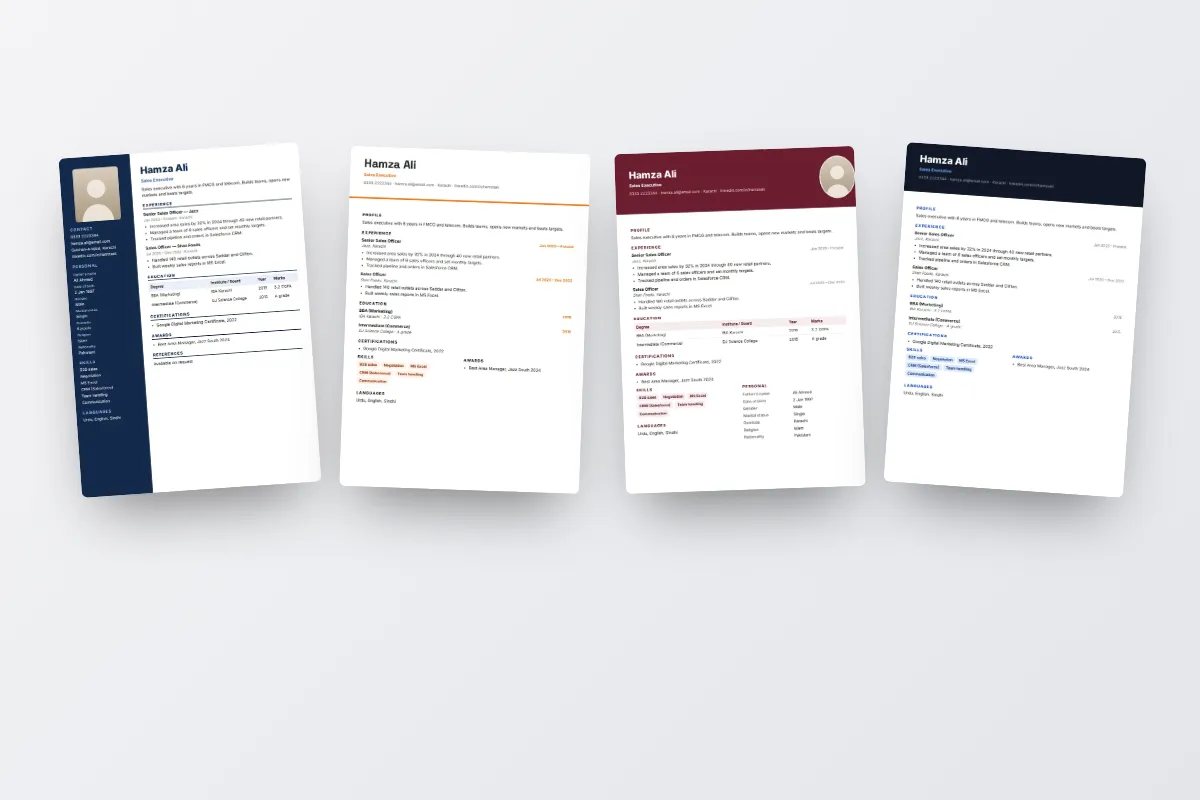
CV vs resume: side-by-side comparison
| Pakistani CV | Resume | |
|---|---|---|
| Length | 1–2 pages (longer for academics) | 1 page, 2 at most |
| Photo | Usually yes | Usually no |
| Father's name, CNIC, domicile | Often included | Not included |
| Education | Full table with board, year and marks | Highest degree, short |
| Experience | Duties and positions held | Results with numbers |
| Changes per job | Rarely | Yes, tailored each time |
| Best for | Government jobs, schools, local companies | Multinationals, startups, jobs abroad |
Is CV and resume same? Why people mix them up
In the UK and much of Asia, "CV" is the everyday word for any job document, even a one-page one. In the US and Canada, "resume" is the everyday word and "CV" means the long academic version. Pakistan picked up both words, so you'll see job ads use either one for the same thing.
So don't worry about the word in the ad. Look at who is hiring and where. That tells you which format to send.
When to use a CV
- Government jobs: FPSC, PPSC, SPSC, NTS and department posts. They want complete personal details and marks.
- Schools and colleges: teaching jobs usually expect a photo and a full education history.
- Hospitals and local companies: textile mills, pharma distributors, family businesses and banks often still prefer the Pakistani CV.
- University, research or PhD applications: here you need the long academic CV, with publications and research.
Resume or CV for jobs abroad?
For the Gulf (UAE, Saudi Arabia, Qatar, Oman), the UK, Europe, the US and Canada, send a resume. Recruiters abroad get hundreds of applications per role and want one clean page that shows results. Leave off CNIC, father's name, religion and marital status. Leave off the photo too, unless the ad specifically asks for it.
Gulf employers and agencies sometimes do ask for a photo, nationality and visa status. When they do, add only what they ask, in one short line, and keep the rest of the page focused on your work.
The same goes for multinationals in Pakistan (Unilever, Nestle, banks with foreign head offices, big tech firms). Their HR teams follow international practice, so a resume fits better.
Example: one person, two documents
Take Bilal Ahmed, an example accountant from Lahore with 4 years of experience.
For a PPSC post (CV): photo at the top, then a profile, experience with exact dates, an education table (B.Com, Intermediate and Matric with BISE Lahore and marks), then personal information: father's name, date of birth, CNIC and domicile Lahore. Two pages.
For an accounts job in Dubai (resume): no photo, no CNIC. Name, phone, email and LinkedIn at the top. A 3-line summary: "Accountant with 4 years in audit and payroll for a 300-person manufacturer. ACCA part-qualified. Reduced month-end close from 8 days to 5." Then experience as results, then education in two lines (ACCA, B.Com). One page.
Same person, same history, different packaging for a different reader.
What about a cover letter?
A cover letter is a separate, short message that goes with either document. Abroad and at multinationals it is often expected; for Pakistani government jobs it is usually replaced by the department's own application form. Keep it to three short paragraphs: which job you are applying for, the one or two results that make you a fit, and a polite line asking for an interview. When you email your CV or resume, the email body itself can be your cover letter, so don't leave it empty with just "PFA CV".
Resume format tips that work everywhere
- Put your most relevant experience in the top half of the first page.
- Write bullets as actions with numbers: "Cut stock losses by 15%" beats "Responsible for stock".
- Use standard headings (Experience, Education, Skills) so ATS software can read them.
- Save as PDF, named with your name: "Bilal-Ahmed-Resume.pdf".
- Keep a CV and a resume ready. You will need both.
Make both, without typing twice
For local and government jobs, use the CV maker: 8 designs including Government CV and Simple Classic, with photo, father's name, CNIC and domicile all optional. For multinationals and jobs abroad, use the resume maker: 8 modern one-page designs like Orange Line, Dark Header and Serif Elegant, with no photo by default. Both show a live preview as you type, every design is free, and you download a PDF or a picture when you're done.


